
Knight of Swords
Explore Knight of Swords through upright and reversed meanings, love and career interpretations, yes-or-no guidance, symbolism, and deeper practical insight.
This card page is maintained as a two-layer reference: quick meaning first, then deeper symbolism and practical application. The editorial goal is to make Knight of Swords readable both for a fast scan and for deeper study.
Card Family
Swords suit
Card Number
12 in Swords
Element
Air
Core Keywords
action, impulsiveness, defending beliefs
Core Takeaways
- +Knight of Swords should be read through the question and spread position before any fixed upright-versus-reversed shortcut.
- +This page separates core meaning, deeper symbolism, and practical lenses like love, career, and yes-no so the card stays readable at different depths.
- +As a Swords card, its suit pattern is as important as its individual imagery.
How This Page Was Built
- +Short meanings come from structured deck metadata so the top of the page stays scannable.
- +Long-form sections add symbolism, history, psychology, and correspondences when the deeper reference file is available.
- +FAQ pairs are parsed into structured data so the same card guidance is readable to both users and search systems.
Sources Referenced
A.E. Waite, 1910
Foundational Rider-Waite-Smith reference for card structure and symbolism.
Rachel Pollack, 1980
Widely used modern interpretive framework for card interactions and spread reading.
Benebell Wen, 2015
Comprehensive modern manual covering card meanings, spreads, and reading technique.
Full bibliography: References. Review process: Editorial Policy.
Knight of Swords Quick Meaning
Upright
Action, impulsiveness, defending beliefs, ambition
Reversed
No direction, disregard for consequences, unprepared, reckless aggression
Core Theme
action, impulsiveness, defending beliefs
Read in Context
Read Knight of Swords through the question, spread position, and surrounding cards before narrowing it into love, career, money, or yes-or-no guidance.
Keywords
Upright Meaning
Action, impulsiveness, defending beliefs, ambition
Reversed Meaning
No direction, disregard for consequences, unprepared, reckless aggression
Browse all reversed meaningsFull Interpretation
The Knight of Swords represents action and defending your beliefs.
Is Knight of Swords a Yes or No?
Full verdict →Conditional
Leaning No
The Knight of Swords is conditional: swift intellect and decisive drive can succeed, but reckless charging leads to mistakes.
In-Depth Analysis
Historical Background
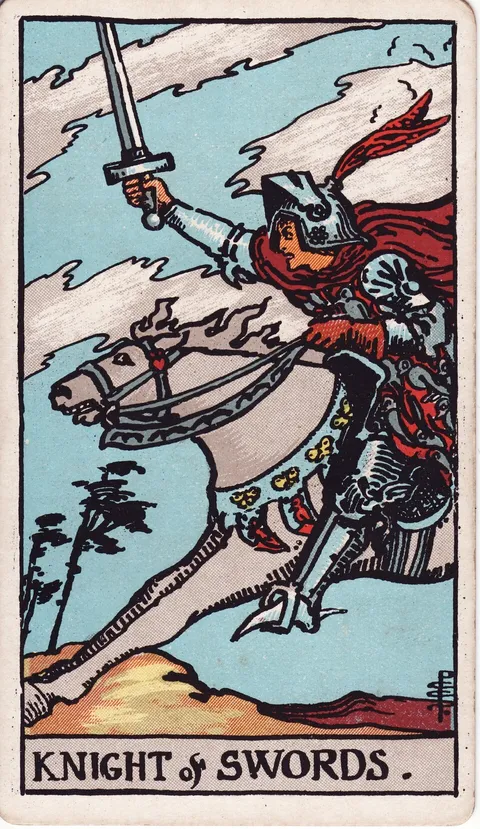
The Knight of Swords is a Minor Arcana card in Swords, concerned with thought, language, conflict, and truth. In the Rider-Waite-Smith deck, a rider charges forward with a raised sword through rough wind. As a Knight, it often appears as a person, a tone of behavior, or a way the questioner is learning to handle thought, language, conflict, and truth.
The Minor Arcana developed from suited playing-card traditions, but the Waite-Smith images turned each pip and court card into a readable scene. For the Knight of Swords, that scene asks: Where is speed turning conviction into force? Upright, the card usually points toward action, impulsiveness, defending beliefs, ambition. Reversed, it can show no direction, disregard for consequences, unprepared, reckless aggression, or thought under pressure: confusion, harshness, avoidance, or mental overload.
Symbolism & Imagery
The Knight of Swords turns the sword into a concrete scene: a rider charges forward with a raised sword through rough wind. The court figure matters as much as the sword: this card may describe a person, a role, or the way the suit's concerns are being handled. That is why this card should be read through action, posture, and context, not by keywords alone.
Upright, the image points to action, impulsiveness, defending beliefs, ambition. Reversed, it can show no direction, disregard for consequences, unprepared, reckless aggression, or a distortion of the same pattern. When it appears with other Swords cards, the suit story becomes stronger. When it appears with Major Arcana cards, the everyday situation may be tied to a larger life lesson.
Psychological Insights
Psychologically, the Knight of Swords asks how the questioner is handling action, impulsiveness, and defending beliefs in real life. As a court card, it may describe a person in the situation, but it can just as often describe a habit, stance, or maturity level. The card is most useful when read as behavior under pressure rather than as a label placed on someone.
In practical terms, it points to how the mind frames a problem, defends a position, or names a difficult truth. Upright, it tends to show a workable expression of the suit. Reversed, it asks where the same energy is blocked, exaggerated, avoided, or badly timed. In a relationship reading, this may describe a pattern between people; in career or money readings, it often describes process, discipline, or decision quality.
Correspondences
Core correspondences for Knight of Swords: Swords, element of Air, Court role: Knight. The suit links the card to thought, language, conflict, and truth; the rank or number shows how that theme is moving.
For practical reading, keep the correspondence simple. Swords cards often answer through how the mind frames a problem, defends a position, or names a difficult truth. The Knight of Swords narrows that field to the question: Where is speed turning conviction into force? If a spread has many Swords cards, the suit theme is probably central; if this card stands alone, it may mark the one material, emotional, mental, or creative pressure point the reading wants you to notice.
Frequently Asked Questions
What does the Knight of Swords mean upright? Upright, the Knight of Swords points to action, impulsiveness, defending beliefs, ambition. Read it through the question and spread position before treating it as advice, timing, or direction.
What does the Knight of Swords mean reversed? Reversed, the Knight of Swords can show no direction, disregard for consequences, unprepared, reckless aggression. It may also mean the upright energy is delayed, private, excessive, or difficult to express.
Is the Knight of Swords a yes or no card? It is conditional. Upright, its themes may support the question: action, impulsiveness, defending beliefs, ambition. Reversed, it asks for timing, caution, or a clearer question.
How should I read the Knight of Swords in a spread? Look at its position and suit pattern first. In advice, it asks where is speed turning conviction into force? In an obstacle position, it often shows the same theme blocked or overused. Always compare it with the neighboring cards before deciding whether it describes advice, timing, a person, or the main issue.
Practical Readings
Love Reading
In love, Knight of Swords upright signals Action, impulsiveness, defending beliefs, ambition. Reversed may indicate No direction, disregard for consequences, unprepared, reckle.
Career Reading
For career, Knight of Swords upright suggests Action, impulsiveness, defending beliefs, ambition. Reversed can mean No direction, disregard for consequences, unprepared, reckle.
Money Reading
For money, Knight of Swords upright points to Action, impulsiveness, defending beliefs, ambition. Reversed asks you to review No direction, disregard for consequences, unprepared, r.
Yes / No
Upright: Conditional. Reversed: Leaning No. The Knight of Swords is conditional: swift intellect and decisive drive can succ...
Card Group
More in Swords
Get a Reading with Knight of Swords
Move from card meaning into practice with a focused live reading.
Back to all cards