
The Hierophant
Explore The Hierophant through upright and reversed meanings, love and career interpretations, yes-or-no guidance, symbolism, and deeper practical insight.
This card page is maintained as a two-layer reference: quick meaning first, then deeper symbolism and practical application. The editorial goal is to make The Hierophant readable both for a fast scan and for deeper study.
Card Family
Major Arcana
Card Number
5 in the Major Arcana
Element
Earth
Core Keywords
spiritual wisdom, religious beliefs, conformity
Core Takeaways
- +The Hierophant should be read through the question and spread position before any fixed upright-versus-reversed shortcut.
- +This page separates core meaning, deeper symbolism, and practical lenses like love, career, and yes-no so the card stays readable at different depths.
- +As a Major Arcana card, it usually points to larger life themes or turning points more than everyday logistics.
How This Page Was Built
- +Short meanings come from structured deck metadata so the top of the page stays scannable.
- +Long-form sections add symbolism, history, psychology, and correspondences when the deeper reference file is available.
- +FAQ pairs are parsed into structured data so the same card guidance is readable to both users and search systems.
Sources Referenced
A.E. Waite, 1910
Foundational Rider-Waite-Smith reference for card structure and symbolism.
Rachel Pollack, 1980
Widely used modern interpretive framework for card interactions and spread reading.
Benebell Wen, 2015
Comprehensive modern manual covering card meanings, spreads, and reading technique.
Full bibliography: References. Review process: Editorial Policy.
The Hierophant Quick Meaning
Upright
Spiritual wisdom, religious beliefs, conformity, tradition
Reversed
Personal beliefs, freedom, challenging the status quo, dogma
Core Theme
spiritual wisdom, religious beliefs, conformity
Read in Context
Read The Hierophant through the question, spread position, and surrounding cards before narrowing it into love, career, money, or yes-or-no guidance.
Featured Interpretation
Read The Hierophant through tradition, teachers, and belonging.
Focus
It asks whether a rule, lineage, institution, or shared language is helping you grow or simply asking for conformity.
Watch For
Reversed, it can show useful independence, but also rebellion that has not yet become a real value system.
Best For
Commitment, mentorship, spiritual practice, education, marriage, and decisions involving community standards.
Keywords
Upright Meaning
Spiritual wisdom, religious beliefs, conformity, tradition
Reversed Meaning
Personal beliefs, freedom, challenging the status quo, dogma
Browse all reversed meaningsFull Interpretation
The Hierophant represents spiritual wisdom, tradition, and conventional belief systems.
Is The Hierophant a Yes or No?
Full verdict →Conditional
Conditional
The Hierophant gives a conditional answer: it leans yes if adhering to proven methods or shared values serves the situation.
In-Depth Analysis
Historical Background
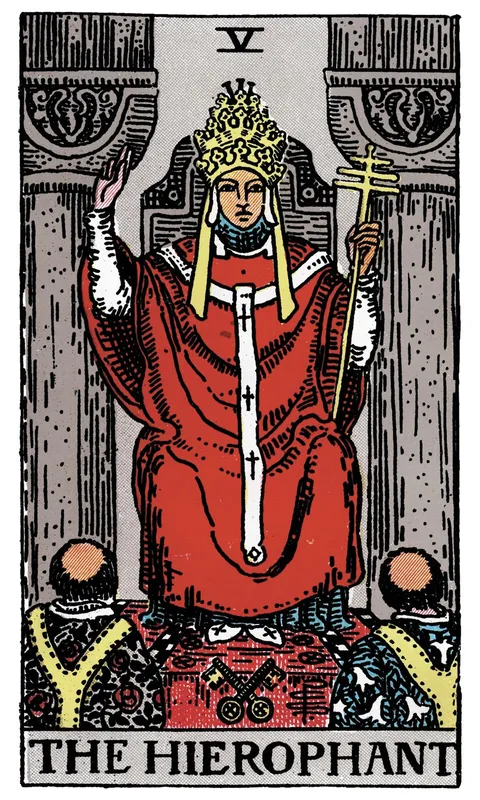
The Hierophant is card 5 in the Major Arcana, part of the tarot sequence that deals with turning points, identity, and lessons that feel larger than one practical choice. In the Rider-Waite-Smith deck, a religious teacher raises one hand in blessing while two figures kneel before him. The image keeps the card grounded: it is not an abstract slogan, but a moment where teaching, tradition, initiation, and shared belief can be seen and read.
Historically, the Major Arcana grew from early European trump cards into a symbolic sequence used by modern readers for reflection and interpretation. The Hierophant is usually read as teaching, tradition, initiation, and shared belief. Upright, it points toward spiritual wisdom, religious beliefs, conformity, tradition. Reversed, it often shows the same lesson under pressure: personal beliefs, freedom, challenging the status quo, dogma.
Symbolism & Imagery
The key to The Hierophant is the visual tension in the scene: a religious teacher raises one hand in blessing while two figures kneel before him. The card works because it holds both the useful and risky side of its theme. At its clearest, it shows learning from a lineage without surrendering judgment. Under strain, it can become dogma, conformity, or borrowed conviction.
In a spread, do not read The Hierophant as a fixed direction by itself. Read where it lands. In an advice position it may ask for learning from a lineage without surrendering judgment; in an obstacle position it may show dogma, conformity, or borrowed conviction; near softer cards it can be gentler, while near harsher cards it becomes more urgent. The surrounding cards decide whether its lesson is opening, blocked, or already in motion.
Psychological Insights
Psychologically, The Hierophant describes a pattern of attention: how someone meets teaching, tradition, initiation, and shared belief. It can show an outer event, but it is often more useful as a mirror for posture, motive, and readiness. The practical question is: Which rule is worth keeping, and which one needs testing?
For self-reflection, use this card to separate mature expression from shadow expression. Learning from a lineage without surrendering judgment is different from dogma, conformity, or borrowed conviction. A good reading keeps that distinction alive, especially in love, career, or decision questions where a dramatic card can otherwise be overread.
Correspondences
Core correspondences for The Hierophant: Major Arcana, card 5, and the element of Earth in this reference system. These correspondences are useful as reading aids, not as fixed rules. The card's first job is still to answer the question through image, position, and surrounding cards.
For practice, pair The Hierophant with themes of teaching, tradition, initiation, and shared belief. If it appears as advice, ask: Which rule is worth keeping, and which one needs testing? If it appears as a block, look for dogma, conformity, or borrowed conviction. When journaling, track whether the card is describing timing, choice, inner posture, or an external situation.
Frequently Asked Questions
What does The Hierophant mean upright? Upright, The Hierophant points to spiritual wisdom, religious beliefs, conformity, tradition. Read it through the question and spread position before treating it as advice, timing, or direction.
What does The Hierophant mean reversed? Reversed, The Hierophant can show personal beliefs, freedom, challenging the status quo, dogma. It may also mean the upright energy is delayed, private, excessive, or difficult to express.
Is The Hierophant a yes or no card? It is conditional. Upright, its themes may support the question: spiritual wisdom, religious beliefs, conformity, tradition. Reversed, it asks for timing, caution, or a clearer question.
How should I read The Hierophant in a spread? Look at its position first: it can show a lesson, a pressure point, an invitation, or a consequence depending on where it lands. Always compare it with the neighboring cards before deciding whether it describes advice, timing, a person, or the main issue.
Practical Readings
Love Reading
In love, The Hierophant upright signals Spiritual wisdom, religious beliefs, conformity, tradition. Reversed may indicate Personal beliefs, freedom, challenging the status quo, dogma.
Career Reading
For career, The Hierophant upright suggests Spiritual wisdom, religious beliefs, conformity, tradition. Reversed can mean Personal beliefs, freedom, challenging the status quo, dogma.
Money Reading
For money, The Hierophant upright points to Spiritual wisdom, religious beliefs, conformity, tradition. Reversed asks you to review Personal beliefs, freedom, challenging the status quo, .
Yes / No
Upright: Conditional. Reversed: Conditional. The Hierophant gives a conditional answer: it leans yes if adhering to proven me...
Card Group
More in Major Arcana
Get a Reading with The Hierophant
Move from card meaning into practice with a focused live reading.
Back to all cards